On January 24th, Elizabeth Hoffecker and Kendra Leith, Co-Principal Investigators for the ASPIRE Project, and researchers at the Massachusetts Institute of Technology (MIT), shared the results of their diagnostic study of the UVG innovation ecosystem with leaders from the Universidad del Valle de Guatemala (UVG). The diagnostics results that were shared had been collected over the past year by a team of MIT researchers, UVG professors, and UVG anthropology students.
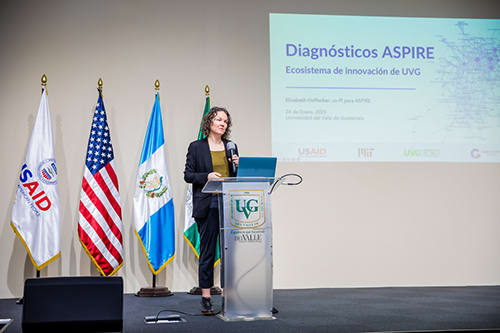
Hoffecker began her presentation by sharing the definition of “Innovation Ecosystem” in the context of ASPIRE. This term refers to “a community of interconnected actors, based in a specific place, who interact in order to create innovation and support innovation processes, along with the resources, infrastructure and enabling environment that allows them to develop and disseminate better ways of doing things.”
The diagnostics that were shared had been collected in three phases. The first phase involved 66 interviews that were held with key stakeholders from the three UVG campuses (Central, Highlands, and South). During these interviews, the team identified 175 stakeholders who were subsequently sent surveys during the second phase of the diagnostic collection process. Phase three included 85 in-depth interviews with additional professors, researchers, administrative staff, program directors, authorities, and students, among others.
The findings from these conversations highlight that UVG has many of the key elements necessary for a strong innovation ecosystem, such as talented staff and students, a strong existing reputation in research, science, and technology, and infrastructure for innovation. Prime examples of this include the Center for Innovation and Technology (CIT), UVG makerspaces, and UVG laboratories available on the campus.
Another strength that was identified in supporting a strong innovation ecosystem at UVG was the complementary nature of the three campuses, which function as three innovation sub-ecosystems. The Central Campus’s innovation culture is focused around it’s “maker culture” and supporting maker spaces. . The Highlands Campus has students and staff with a strong entrepreneurial spirit focused on addressing local challenges and opportunities, with a stronger focus on social innovation . The South Campus’ ecosystem is more focused on innovation with relevance to industry and the private sector, reflecting the origins of the campus and its local economic context.
Taking the above into account, the diagnostics presenters emphasized that the ASPIRE Project will launch a new UVG Entrepreneurship Center at the Central Campus, which will serve as a hub to integrate and link activities across all three campuses, while supporting entrepreneurs and budding entrepreneurs within the UVG community.
Relationship Among the Stakeholders: Summary of Findings
An equally important finding from this part of the diagnostics was a need for the university’s leadership to jointly review the guiding purpose of the UVG innovation ecosystem and work towards a vision for the ecosystem’s purpose and key results that they could all embrace. To this end, the ASPIRE team, led by Ms. Hoffecker, held a workshop with university leaders to collaboratively map out a shared vision for the future of the innovation ecosystem.
Curricular, Extracurricular, and Research Activities
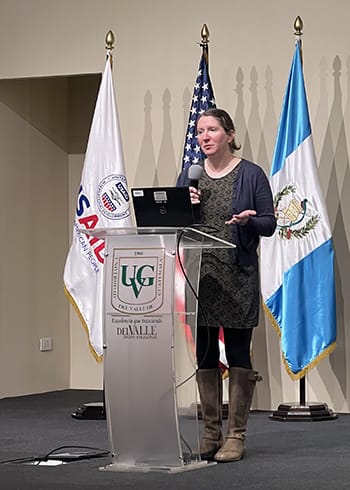
During the presentation, Kendra Leith also shared results of diagnostics focused on UVG curricular/extracurricular activities, and research and research translation activities. Similar to the diagnostics given during Hoffecker’s presentation, the findings shared by Leith were produced through interviews conducted with key stakeholders from the innovation and entrepreneurship ecosystem of the three UVG campuses. These key stakeholder groups included students, professors, authorities, and researchers from UVG, and representatives from AGEXPORT.The team also conducted surveys with students, teachers, and researchers from UVG and representatives from AGEXPORT.
Results regarding curricular activities showed that UVG offers courses on research, innovation, and entrepreneurship on all campuses. They also highlighted students’ motivation to take these courses to expand their knowledge and skills, and apply them in impactful ways in the real world. Students also highlighted their interest in the courses and the importance of the course to their field/area as motivating factors, among others. Through ASPIRE, UVG is adding content to existing courses, and offering incentives for professors to incorporate materials related to the themes of research, innovation, and entrepreneurship into their classes.
Regarding extracurricular activities, the diagnostics showed that UVG already offers various activities that align with research, innovation, and entrepreneurship. These activities take the form of workshops, projects, and competitions, among others. The main factors that enable student participation in these initiatives are support from professors, availability of opportunities, infrastructure (such as space, laboratories, and equipment), time availability, and interest in the activities.
The diagnostic results yielded information regarding opportunities to involve students in activities through training, learning exchanges, and trips focused on entrepreneurship and innovation. The ASPIRE project is also implementing student internships with the private sector through AGEXPORT and will continue to carry out student exchanges within MIT. The project will also centralize extracurricular opportunities through a calendar of activities managed by the Entrepreneurship Center and make it available to students and other members of the UVG community.
Regarding research, participants in the diagnostics highlighted the strengths of the 11 research centers already established at UVG. Specific strengths that were mentioned included technical areas, UVG’s research reputation, infrastructure, and links with other universities and communities, among others. AGEXPORT representatives who participated in the diagnostics highlighted UVG’s focus on innovation, research orientation and experience in research, quality of the researchers, professors, staff, connections to other universities, and available infrastructure as strengths, among others.
Moving forward, ASPIRE seeks to expand capacities related to research translation, collaborative approach, lean research, and interactions with indigenous communities. ASPIRE will also provide funds for research projects and make efforts to generate stronger connections between academia, the private sector, and communities to move from research to action and create impact through locally-generated solutions to local problems.
At the conclusion of the presentation, Dr. Mónica Stein, UVG Research and Liaison Vice-Rector, thanked the MIT researchers for their work on this study, which provides essential information to shape the project’s future work plans, and supports the university’s vision for growth and improvement in research, innovation and entrepreneurship.

También te puede interesar
Los proyectos de Ing. Electrónica, Mecatrónica y Biomédica van avanzando
OES marca línea para Política Nacional de Innovación Productiva