By M. Sc. Sheilee Diaz, Dra. Marilyn Felkner y M. Sc. Renata Mendizábal.
Sure! Here’s the English translation:
By M.Sc. Sheilee Diaz, Director of the Master’s Program in Epidemiology; Dr. Marilyn Felkner, Faculty Member at UTA; and M.Sc. Renata Mendizábal, Researcher at CES-UVG.
November 18, 2024, marked the beginning of a new chapter in international academic collaboration. On this date, the Universidad del Valle de Guatemala (UVG) and the University of Texas at Austin (UTA) signed a cooperation agreement aimed at promoting and developing academic collaboration between both institutions. This agreement establishes a platform to facilitate the exchange of students, faculty, and researchers, as well as the joint development of academic and research activities in strategic areas for public health and the training of professionals in science and health.
Since the signing of the agreement, a series of concrete actions have been implemented that reflect the shared commitment of both universities to foster collaborative networks, strengthen capacities, and contribute to the training of new generations of professionals with a global vision.
Between January and May 2025, a range of activities have been carried out — from the development of a community health promotion strategy to specialized seminars and academic journal clubs for students from both institutions.
Health promotion: students lead interventions on priority topics
One of the key components of the agreement has been the creation of hands-on learning experiences for university students. To date, eighteen students (nine from UTA’s Public Health Issues of Global Concern course and nine from UVG’s Master’s in Epidemiology) are actively participating in the use of the PERIE framework for evidence-based public health. Each student chose one of three priority topics: rabies prevention, antimicrobial resistance control, and vaccine acceptance.
UTA students reviewed literature to define the problem (P), establish an etiology (E), review recommendations (R), and select a previously implemented intervention (I). UVG students served as consultants sharing their perspectives as Guatemalan graduate students and health professionals. Based on input from their Guatemalan partners, the UTA students completed the final step in the PERIE process—evaluation. They suggested adaptations to the selected intervention to make it more effective in a Guatemalan setting.
These student-led initiatives have involved the design of communication strategies, development of culturally appropriate educational materials, and engagement with local communities to better understand perceptions and challenges around these public health issues. UTA students gave universally high evaluations to the UVGs students, evidence that the interaction was valuable and enjoyable.
Academic Exchange: UTA participates in journal clubs lead by UVG
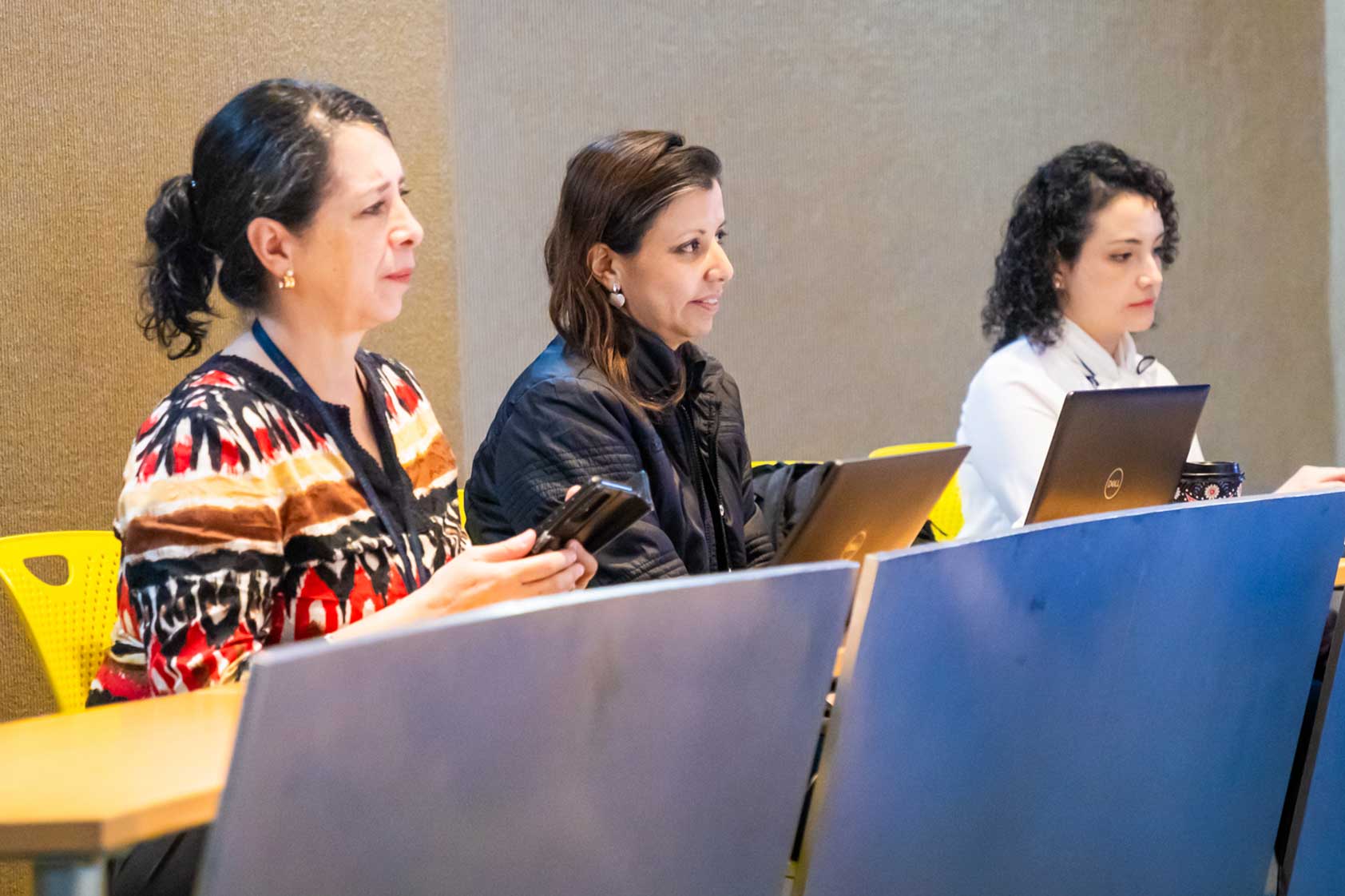
Another significant achievement this semester has been the active participation of UTA students in academic activities hosted at UVG. Specifically, students from UTA’s undergraduate Public Health Program and first-year students from UVG’s Master’s in Epidemiology program have participated in the journal club sessions of the course Outbreak Investigation and Other Public Health Emergencies, facilitated by UVG’s Department of Epidemiology.
The journal club focused on the critical analysis of scientific literature related to health emergencies. Discussions included case studies of outbreak responses, critiques of the methodologies used in the articles, and reflections on the practical implications of these studies.

Dr. Marilyn Felkner.
These sessions brought together epidemiologists and researchers with students from both UVG and UTA, creating a multicultural and multidisciplinary learning environment. The collaborative discussions centered on recent articles related to epidemic outbreaks (topics of foodborne, respiratory and febrile diseases and sexual transmitted and healthcare associated infections), field research methods, and rapid response strategies for public health emergencies.
Dr. Marilyn Felkner leads journal club on foodborne outbreaks
One of the journal club’s most outstanding sessions was facilitated by Dr. Marilyn Felkner, a professor at UTA with extensive experience in public health. She led the discussion of a scientific article focused on the investigation of a foodborne disease outbreak.
During the session, Dr. Felkner not only provided a critical analysis of the article but also shared her personal field experiences. She discussed topics such as epidemiological tracing, decision-making under pressure, and logistical challenges faced by outbreak response teams.
Dr. Felkner’s participation greatly enriched the academic discussion and created an inspiring environment for students, who had the opportunity to engage directly with an international expert. This session exemplifies the value of the UVG–UTA partnership in providing quality academic experiences for Guatemalan students.
Guest lectures from the center for health studies
UVG’s Center for Health Studies (CES) has also actively contributed to the academic exchange through the organization of two guest lectures for students in the Public Health Issues of Global Concern course. These lectures covered the topics of antimicrobial resistance, and vaccine hesitancy from both technical and social perspectives.
CES researchers Dr. Brooke Ramay and Dr. Herberth Maldonado delivered the lectures, sharing recent research findings, lessons learned from community engagement efforts, and reflections on public health challenges in the region. These sessions provided valuable insights and served as a platform for connecting academic knowledge with real-world public health issues.
This afforded UTA students an unprecedented opportunity to hear and address questions to world renowned experts whose work they had studied in their scientific literature reviews. They learned firsthand as Dr. Ramay and Dr. Maldonado fielded questions on the interaction of health care providers and public health practitioners in mitigating both vaccine hesitancy and antimicrobial resistance.
Institutional strengthening and future outlook
Beyond the specific activities described, the first semester of the agreement’s implementation has provided an opportunity to strengthen institutional ties between UVG and UTA. Both universities have made progress in identifying priority areas for future collaboration.
The international relations offices of both institutions have played a key role in facilitating the coordination of this agreement. It is widely recognized that international cooperation requires not only academic will, but also strong administrative structures to ensure effective and sustainable implementation.
Impact
The initial months of implementing the cooperation agreement between Universidad del Valle de Guatemala and the University of Texas at Austin have demonstrated the great potential of international academic collaboration. The activities carried out between January and May 2025 have not only strengthened institutional ties but also created meaningful spaces for learning, exchange, and reflection for students, faculty, and researchers.
This agreement represents a commitment to higher education that is more globally connected, collaborative, and engaged in transforming the social and health realities of our communities. In the coming months, the scope of activities is expected to expand, new areas of collaboration will be explored, and the foundation for a long-lasting and transformative partnership will continue to grow.
More information about the Master’s in Epidemiology at the link.

También te puede interesar
Epidemiología en acción frente a la Enfermedad Renal Crónica en Guatemala
Estudiantes de la Maestría en Epidemiología de UVG presentan manuscritos científicos
ECHO avanza con éxito: egresados de Maestría en Epidemiología UVG impulsan iniciativa